About me+
German version of this arcticle/Deutsche Version des Artikels
Short: About skalabyrinth
skalabyrinth is a German artist and author living in Kiel. They is best known for their fantasy sci-fi series Myrie Pliers, a coming-of-age story with an autistic main character. skalabyrinth is autistic themself and, with the six-volume utopia (SolarPunk), they has embarked on a long journey of healing – from wounds that society inflicts on autistic entities, but also about striving for an image of society in which we can all live better, breathe in relief, rest and recover.
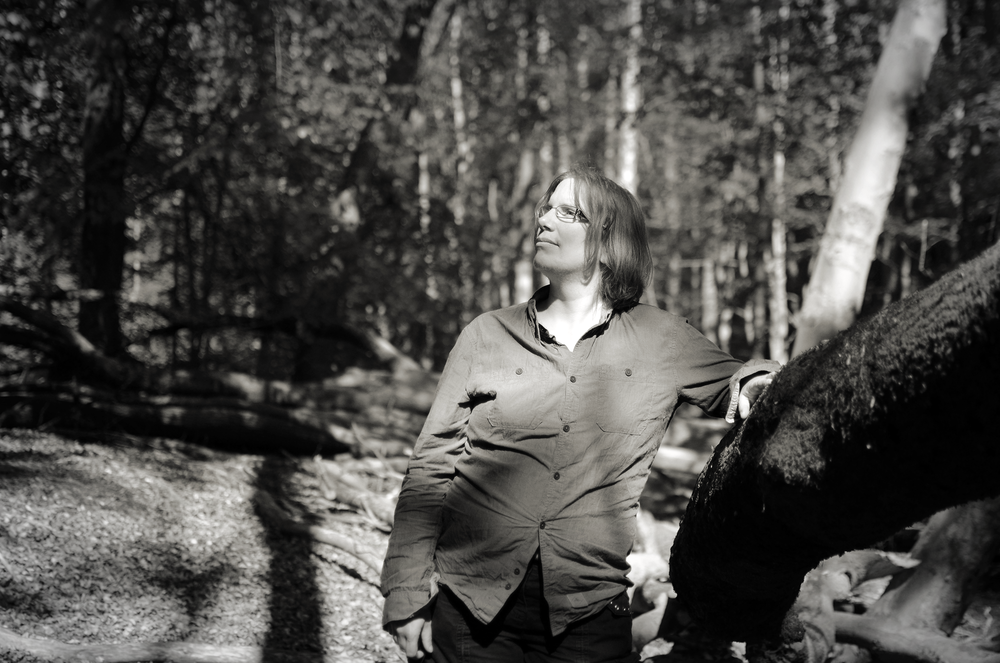
The fabulous photograph was taken by Ann Teegen.
My art in the respective context of my life
First Things on this homepage
In 2014, I developed the idea of filling a homepage with my art: with pictures, stories, poems, comics, photos, music. The idea has always been to license all content freely and make it freely accessible. At that time I have long been friends with neocturne, who still supports me with every problem concerning my homepage. The homepage runs on her rented hardware, she explained to me how to domains, and by this it could start quickly.
First I uploaded pixel art here. My pixel images may suggest that I have a special relationship to fish and underwater worlds.
Explosive Vegetation
When I try to summarize more about myself adequately, it always feels wrong. I am a vegetation of impressions that exploded. Nothing belongs together. Accordingly, my site has grown and I always sort it carefully so that there is still structure.
I don’t belong anywhere. I don’t have the impression that I can write that I’m part of the queer scene or anything, because no matter where I go, I quickly realize that I don’t belong there either. I don’t have a single solid identity or a sense of who I am. I cannot be put together into a simple picture. I’m kind of a puzzle picture (a picture showing many different elements where you have a hard time getting an overview).
My last attempt at self-introduction was a label collection. On the one hand, it was relatively easy because the form was nicely predetermined, but on the other hand, I don’t feel comfortable with it. That’s why this time I’m trying to embed my art in the context of my life from which it emerged.
I am a fish
I’m a fish. That’s how I declared myself since childhood. Sometimes I am asked why, and answer in varying detail. I like the sea, I like to swim, I feel more comfortable in the water than on land. Fish are not so easy to catch and hug, they slip away. But I think it also has something to do with autism and trauma: Since my youth at the latest, I haven’t really felt like I belong to human beings because I was so different, but also because I didn’t feel like I could keep up: As if I lacked a few capabilities to be allowed to call myself human.
Being a fish has taken that burden off my shoulders. I felt comfortable and enough in it.
Today, the reasons why it developed like so may be partially overcome. I’m still a fish.
Underwater Photography
In 2016, I somehow came up with the idea of photographing the worlds I see while snorkeling. I think that’s when I really started snorkeling. I bought a waterproof hull for roughly 2-3€, a pre-owned smartphone for 35€ (my first), and swam through the Baltic Sea with it.
There were some problems:
a) The Baltic Sea is salty. It pressed the touch foil onto the display, which as a result felt touched everywhere. My additional finger on the trigger button was of no interest. I solved the problem by carving a frame that fit snugly into the hull. I stretched an air cushion over the display and I was able to press the button. Due to the tension, the hulls leaked every 1-2 years, but that was manageable.
b) I can’t see well without glasses and contact lenses don’t work well for me. So I didn’t see what I was photographing.
I also have this problem with bird photography: I can’t see things well that move on the retina (this includes text that I read and that moves on the retina as a result). Therefore, I can read quite poorly and do not see moving objects or hardly see them when I photograph them.
Accordingly, I often have photographs that surprise me.
I think that’s one of the reasons why I didn’t start snorkeling until I was taking photographs, because then at least I find out afterwards what I could have seen if I could see well.
I have switched to an underwater camera since 2019 and have taken thousands of photos over the years. Some of them are in the Sea Life category.
Difficulties reading and audio books
I have dyslexia or this visual disability where I can’t see things well that move, or both. Probably both.
Unlike many others with dyslexia, I was able to memorize how words are written through much, much practice in my school days. But when I hear a new word that I don’t know yet, I usually don’t have the slightest idea what it might look like written in letters. In addition, when I write, there is always a spell checker in my head that checks every word before I write it. I notice it when I get a bit tired and start writing words phonetically. Probably I could write something like: “I wood go to a carpenter”, especially because the context of wood is given here.
In consequence, usally it is not so noticeable to others when they read my writing that spelling could be an issue for me. I am in fact relatively well able to write with few spelling mistakes, although it is very exhausting for me and from time to time I don’t accept that I should because I find alternative spellings to be enriching.
But reading is an issue. Reading is very difficult for me. I read a little slower than speaking speed. And when I read, I first transform the text into an audio track in my head, which I then listen to in order to capture the content from it.
But the worst thing about reading, I think, is being understimulated. I can’t stand it very well not to be able to absorb input at the speed that suits me.
When I listen to vlogs or podcasts or lectures or something like that, I usually do it at about double speed because it suits my receptivity. And I usually do something artistic at the same time, like painting, drawing or playing Minecraft. Otherwise, my concentration drifts away from what is being said and my fingers feel restless.
Text-to-speech became a very helpful tool for me. I use it to read digital text that is longer than a few lines. It doesn’t always work well for me. I have the impression that a hearing medium would structure a text differently, so that more time is spent in the places where information is dense. However, in order to adjust the speed of my text-to-speech depending on the content being read aloud, I would have to have my hands free and not draw anything at the same time.
In any case, my brain can’t absorb masses of information. Output is much easier for me than input. Writing a book is easier than reading one.
And, perhaps already assessable up to this point: I can listen to an audio book better than read a book visually. I always much preferred to consume books as audiobooks. In addition to the book itself, I also like the vocal theatre of audio books. I don’t listen to audio books at an increased speed – I wouldn’t with music either –, because the art of voice modulation and the theater in it gives me the additional input not to be understimulated or underchallenged.
I ran into the problem that I wanted to read my favorite books a second time, but with all the determination in the world I couldn’t. I couldn’t get myself through the agony of doing this reading thing a second time, just to get the input I already knew. I also had the thought that this could even happen to me again: I could feel the need to read my favorite book a third or fourth time, and then I would have to go through it another time, again.
I came up with the idea of creating audio books from my favorite books. I expected that I would have to be very bad at it because of my reading difficulties, but that wasn’t the case at all. I simply cut out all my reading errors. And that’s how I ended up making audio books. It’s become a big hobby of mine.
Through a lot of practice, I became pretty good over time. Recently, someone said that my audiobook production of “Der Feuervogel von Istradar” by Ria Winter sounded very professional. (I haven’t produced any English audio book yet, but some poems, line the poem “I’d dance”. Maybe I have a horrible German accent. I will need some time to get confident enough to produce a whole English audio book.)
I mainly read my own books, but I am also interested in reading some books from other authors.
Fun fact: It’s easier for me to beta read a text than to just read it. The thoughts I have about what I write in the margins fill the understimulated part of my brain to some extent.
Music
Music is my breath. I insisted early in my life that I wanted to learn musical instruments. I started to love recorders when I wasn’t yet in elementary school, and at 10 I started learning to play the piano. Around that age, I wrote one of the sentences that mean a lot to me in my book of secrets: “You can tell with tunes. Much more than with the mouth.” My 11-year-old self, a few months later, commented on some things in said book with the word “nonsense”, but under this sentence there is a “yes”, with a date. We agreed on that at the time.
Music is a trauma language for me. It was the only language in which I could really express my feelings. I was able to get in touch with parts (perhaps people) of me through tunes, where a connection was otherwise impossible.
My dream was and still is to write and release music. Some results can be found on my homepage, such as the German concept album Luzeva. It is about the angel Luzeva, who, unlike the other angels, also helps in hopeless cases, and is thrown out of heaven for it. Luzeva feels disempowered by this and wants to take her own life. In the process, she encounters Death and learns that she cannot decide on her being alive at all, because she is a thought that lives as soon as people believe in it. She is hope.
Another concept album in the works (since 2017 or so) is called “Meerflucht” (Flight of the sea) and will touch on just about every trauma I’ve experienced. It has a completely different quality musically than “Luzeva”. While all the tracks of “Luzeva” were created on a workshop weekend, “Meerflucht” is a thoughtfully constructed work with a band I had at the time. The recording hardware is also not randomly borrowed, but self-selected, and has become an integral part of my equipment. A foretaste of the album is provided by the Traumflucht Intro.
My music is, from my perspective, dark and beautiful. And very personal. On the one hand, I have no problems with publishing my music onto my homepage, on the other hand, I notice how I can’t stand the nervousness and drift out of my emotional costume because it’s so hard as soon as I play it to someone else in persona.
(The music part is mostly created by felis.)
Myrie Pliers
In 2016, I started to develop Myrie Pliers. I had written a lot of stories that almost no one had read, and my strategy this time was to ask those around me what they would like to read in order to write something where that could be different.
The result was something that means a lot to me. Around 2018, after a discarded first version of Myrie in young adulthood, I started writing the coming-of-age story it is today. Myrie inherits my autistic traits and sense of justice from when I was about 11, before my life dissolved into a traumatic hell. Myrie is not a self-insert — she has many different features than I do. It still occurs to some people who find my autistic traits to be core characteristic of me.
With “Myrie Pliers” I write a story that feels realistic and real to me (there are bullies, but they have no ground to stand on and just do their thing), and at the same time in a way that wouldn’t have traumatized me.
This is very wholesome and healing.
I like to observe, I like to perceive. The wind in the hair on my legs, the coolness under my sun-warmed skin, demanding that I connect with my body, when I was outside half-naked in spring. The inner joy that takes my breath away when someone is unexpectedly there for me or invites me to belong to something. I like to describe perceptions, capture the special feeling in it and process it in my stories. This perception plays a particularly important role in Myrie Pliers.
I am left-wing and fight against discrimination or injustice in general when I perceive it. These struggles can also be found in my stories and perhaps shape this one in particular.
I wanted to write a story that was designed for several volumes, because I missed being able to follow characters for so long that they felt like a coming home. It works for me and I think it’s nice that I kept it that way with this work, which is set in a utopia.
It perhaps represents the antithesis to the dystopian musical works. But over time, it became more difficult to continue writing it because the brain is traumatized and has thrown so many symptoms and problems.
My wish is to be able to return to this work in order to continue it and to complete it at some point.
The turning point in my life
Around 2015, that is around the same time as the beginnings of my homepage, I was in therapy for the first time. I decided to do this because I realized that I have no emotional distance at all from some people. And by that I don’t just mean that everything they experienced touched me very deeply, but that I felt their feelings as my own, even though I actually knew that they weren’t my own at all. I called such feelings “stranger feelings” and processed the phenomenon, as well as others related to trauma and bonding, a few years later (~2020) in my novella “Die Haptik der Wände (which would translate to “The Haptics of Walls”).
Overall, many things in my life have been set in motion with this therapy and the social environment I built up during this time, which I have later captured in stories and articles.
Before this turning point, I was simply convinced that I had had an essentially very privileged, good life. There was so much I wasn’t aware of about myself.
Becoming aware of things has enriched my life at the same time and brought the fragmentation of my perception more and more to light, because, after all, I have experienced these bad things, and I was also everything that I had to hide from the world at that time. Or rather, we were.
Minecraft
Since this turning point, my performance has continued to plummet, although there have also been short better phases on the way to today. Before that, I studied a double degree (mathematics, physics, minor subject computer science), and danced, swam and socialiced every week.
But during my doctoral attempt in theoretical computer science, while I realized in a relationship that did me a lot of good, that I wasn’t actually doing well at all, it just collapsed.
My coping at that time consisted of playing Minecraft. It’s a typical game for me: creative and repetitive (that means things repeat themselves). For half a year, I played many hours a day and built the city of Möhringen (would translate to something like Carrotown), which can be admired in the Minecraft category.
Slut Pride
Shortly before this turining point, I experienced terrible sexual violence, and in this context, instead of support from my old social environment, I was devalued as a slut. It felt so cruel and horrible – I think it was the first time I really realized how bad my old social environment has been for me sometimes.
That was at the beginning of 2013 and it took me another 7 years until I captured my then acquired conviction and my learnings in the article I Am A Slut And I Have My Pride. In 2019/2020, I increasingly decided to make my learnings available to others, because I believe and get corresponding feedback that it helps others who have experienced similar things to feel seen in it, or to feel okay with being queer the way they are.
Queerness
I feel less and less comfortable with queer labels. This is not to say that they are bad or that I don’t use them from time to time. But I have the feeling that they make a lot of queerness that doesn’t fit well into these labels, invisible. For example, slut pride – I feel at least me being a slut and feeling pride in it is very queer, but it doesn’t have an established label and hardly anyone would describe a book, in which a woman, who doesn’t otherwise fit a queer label, describes her life as a sexually very open person and her highlights and struggles with it, as queer.
Vice versa, some of my genderqueer labels provoke that people cannot quite see a reality of life I have, or people don’t know how to name it without misgendering me: As a trans masculine person, I can choose whether I am somehow put in a female corner, or the idea that I could have had the same bottomlessly gruesome life experience of sexual assault as many endo cis women does not seem possible for many. A whole series of my blog articles on my homepage revolve around this conflict. It’s a very nasty struggle that I’m not alone with.
A third reason is that I have the impression that queer labels are somehow perceived as more important or central to identity than other labels. But for me, my autism feels like part of my identity in no other way than my queerness. Being queer is only a fraction of my identity, and yet a large part of my art is very queer in many ways – even the ones I can’t label.
The first queerness I found out about myself was probably that I am polyamorous. When I was about 10, I was in a kind of romantic relationship. We kissed and cuddled and didn’t label the relationship any further. We didn’t even say we were with each other, or anything like that. It just developed into it, and at some point developed away from it again. It was beautiful.
We saw each other during the summer holidays, sometimes also during autumn and spring holidays, and he asked me if he could kiss others during the time we didn’t see each other. My attitude to this was like: Huh, why do you even ask, it’s none of my business? Also, it makes sense, doesn’t it!
Later, I had a monogamous relationship because those around me said that I would never find someone who is polyamorous. It felt very artificial to me and I asked while we were together if my partner could imagine opening up the relationship. He couldn’t. So that was just the way it was.
But because of this early experience, I can at least say what it was like for me before any social norms in this regard had reached me.
By the way, that’s exactly how I write Myrie: exploring, without her taking much notice of how things “should be”.
I live relationship anarchy, I think: Every relationship is individual. It doesn’t have to be labeled romantic. There is so much more in between and perhaps around it.
Being a system and trauma
Most of the art on this site that was not simply a small side project, such as Mermay 2019, came from my journey of self-discovery and my processing of trauma or social rejection. I hope I’m not saying that you have to have trauma to make art. Or that trauma also has good sides. Or that I wouldn’t be very artistic without trauma. It’s more like: Art is a form of expression and what I’m working with in life has a big influence on what I want to express at that moment.
And I want to share. I want to share my resources in which I find confidence in myself, development, strength and self-care, so that my art can also be care and source of strength for others, or it can be material for development or support in finding self-acceptance.
The feedback I get that says something like this worked out, motivates me enormously.
I wrote a long article about the discovery of our system (German) not so long ago, so I’ll keep it very short here: We are plural. There is more than one person in this head. Another of them publishes lesbian romance and erotic under a different pseudonym: Lunis Moon.
DID has not been diagnosed because there is no “full fragmentation”, i.e. we are not completely separate persons. But we have very different emotional experiences, different bonds to our environment, as well as we are different kinds of queer, meaning we have different genders and orientations, for example.
The homepage is certainly not designed by just one person of us. But the writing here is mainly ska, which gives the homepage its name (or vice versa), and the music mainly felis, whereby music has always been a trauma language and has somehow found its way through the system.
When the homepage was created, mainly ska was there in everyday life. But that has changed a lot over time, meaning the content on the homepage will also change emotionally over time.
Maybe it’s not so noticeable. Non-systems (singlets) also change over time. Maybe it’s noticeable. In the two novels Minzaromantik and Machtschattengewächs we try for the first time, in very different ways, to consciously portray being a system in stories, which is not an easy task at all. While Minzaromantik is more of a work by ska, Machtschattengewächs is a collaboration of four other system members.
Final thoughts
I like tea. And clouds. And wind. And rain. And also sun, but sometimes it’s too bright for me. I like to be exposed to nature on a walk and to come home frozen, but I also like the slight glow on my skin from almost getting sunburned during a walk.
I like to use art to make something tangible that would otherwise be difficult to grasp. I like to gently stir.
2026-06-03